Paradoxical Structures
Understanding Contradictions in Organizations
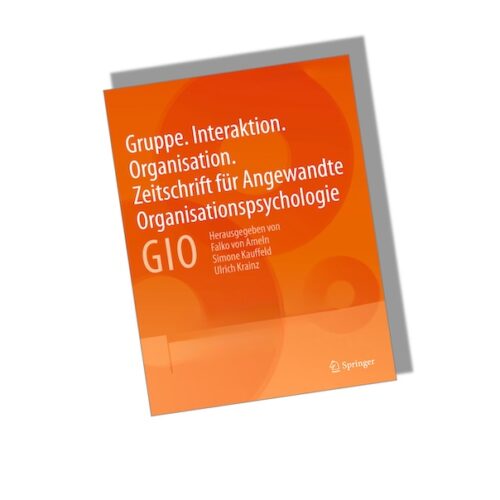
Yesterday, our article on “Paradoxical Structures in Public Authorities” was published in the academic journal Group. Interaction. Organization (GIO) by Springer Nature. I authored this contribution in 2025 together with Ulrike Margit Wahl for the journal 1/2026, section Practice Reports.
The article explores how public authorities and research institutions can become entangled in paradoxical situations arising from the tension between political steering and scientific autonomy.
Paradoxical structures shape all kinds of organizations
and they strongly influence decision-making. Dealing with them constructively can become a powerful lever for successful organizational development. Paradoxes cannot be resolved, yet they can be used productively. Contradictions keep organizations moving; they are a vital source of energy and the foundation of innovation:
Sameness leaves us in peace, but contradiction is what makes us productive.
[Johann Wolfgang von Goethe]
Paradoxes arise when organizations face contradictory demands, goals, or processes at the same time – demands that are interdependent rather than independent. It is precisely this simultaneity that makes paradoxes so difficult to handle. They cannot be solved through simple either or decisions.
Why contradictions are part of everyday organizational life
Organizations constantly operate within fields of contradictory tension. They are expected to work efficiently and reliably, while at the same time remaining flexible and innovative. Leaders are asked to delegate responsibility without losing control. Start-ups, for example, face the dilemma of establishing processes that make operations independent of individuals, while founders remain indispensable as drivers and public faces of the organization.
Typical patterns across different organizations
In our GIO article, we describe a concrete case from the context of public administration and research institutions that clearly illustrates the tension between political control and professional autonomy. However, such dynamics are by no means unique to the public sector. Companies encounter similar challenges, for instance when balancing centralized control with decentralized responsibility, or short-term performance indicators with long-term development.
The case of the US aviation company Boeing – where production pressure and safety requirements escalated into a fatal conflict – demonstrates how dangerous such paradoxes can become. This is why it is valuable to connect insights across different organizational fields.
Paradoxes cannot be resolved
What matters is this: paradoxes cannot simply be eliminated. They differ from situations where several equivalent options exist and a choice can be made or handled sequentially. Paradoxes must be endured, shaped, and used. Communication tends to follow clear logical structures – either A or B. Paradoxes, however, demand thinking in both directions at the same time, or even accepting apparent contradictions.
In management education, this is often referred to as ambidexterity – the ability to pursue two opposing demands simultaneously. Unlike individuals, organizations are able to just do so.
What our GIO article contributes
The article emerged from reflections within the book project “Agile Administration 2040” and is intended as a practice-oriented contribution. Its aim is not to label paradoxical structures as dysfunctional, but to observe and describe them and to jointly explore what purpose they may serve.
Paradoxes are neither a sign of failure nor of incompetence. On the contrary, they often emerge precisely where organizations are highly capable and required to meet multiple, conflicting demands.
Recognizing and acknowledging paradoxes changes the quality of conversations. Tensions become discussable, decisions more comprehensible, and responsibility more realistically distributed. This creates greater room for action—without denying complexity.
Dealing with contradictions in organizational development
In organizational development practice, the focus is therefore less on resolving paradoxes than on developing a constructive way of dealing with them. Leadership means making these opposites visible, discussable, and workable—accepting them as a normal part of everyday organizational life.
Questions such as “What might be the case here, and what could this be useful for?” deserve souverane and non-emotional exploration. Not every decision that restores short-term actionability needs to be treated as a final solution. Learning and adaptation should become – or remain – natural parts of organizational life.
Systemic organizational consulting can support organizations in better understanding their own paradoxes. This helps clarify what can actually be changed and where a conscious, reflective approach is more helpful than yet another optimization effort.
My offer to your organization
In my consulting practice, I support organizations from industry, large corporations, and SMEs in addressing exactly these challenges. I combine systemic perspectives with many years of experience in international and interdisciplinary project work. My aim is to clarify decision-making without smoothing over or relativizing contradictions – and thereby enable effective and sustainable organizational development.

Would you like to better understand and productively use paradoxical structures in your organization? Do you want to create sustainable change rather than running yet another change initiative? Do you want to develop your organization into a learning organization using New Work approaches?
All topics mentioned are eligible for funding for SMEs under the BAFA or INQA programs, with funding rates of up to 80% over six months.
For questions around organizational decision-making or concrete development steps, feel free to visit my website or schedule an initial, non-binding conversation.